The short answer: a memory foam pillow starts as liquid chemicals — polyol, isocyanate and additives — that react and expand into viscoelastic foam inside a shaped mold or a large block, then cure for one to three days, get trimmed, dressed in a sewn cover, inspected, and finally vacuum-compressed for shipping. This article walks through each stage the way it actually happens on a production line, because most explanations online skip the steps that decide whether two pillows of the same model feel identical. We build pillows for OEM brands every day, so we describe the process from the factory floor, not from a brochure.
1. It starts with chemistry, not fabric
Memory foam is a polyurethane. The two main ingredients are polyols (long-chain alcohols that form the flexible backbone) and isocyanates (usually MDI or TDI, which cross-link the polymer). A third stream of additives — water as the blowing agent, catalysts, surfactants, and functional ingredients such as gel particles, bamboo charcoal or plant-based polyol substitutions — decides the character of the foam: how slowly it rebounds, how open the cells are, how it handles heat and humidity. The 'memory' effect comes from engineering the polymer's glass transition close to skin temperature, so the foam softens where it touches you and stays firmer elsewhere.
At the factory, these materials arrive in drums and totes with batch documentation, and incoming inspection matches them against the formulation on the production order. This step matters to buyers more than it sounds: an unrecorded substitution of one polyol lot can shift rebound time, odor and firmness enough that customers notice, even though the pillow looks identical. Our materials page explains the foam families we run — conventional slow-rebound, gel-infused, TPE-coated and low-resilience variants — and what each is for.
2. Foaming: sixty seconds that define the pillow
Production begins when the metering machine injects polyol and isocyanate at a controlled ratio, temperature and mixing speed. The mixture starts creaming within seconds: water reacts with isocyanate, releasing carbon dioxide that inflates millions of cells while the polymer network sets around them. Get the ratio, mold temperature or shot weight slightly wrong and the result is a core that is too dense, too soft, shrinks, or hides internal voids. This is why serious factories log shot weight, component temperatures and line speed for every batch instead of relying on an operator's feel.
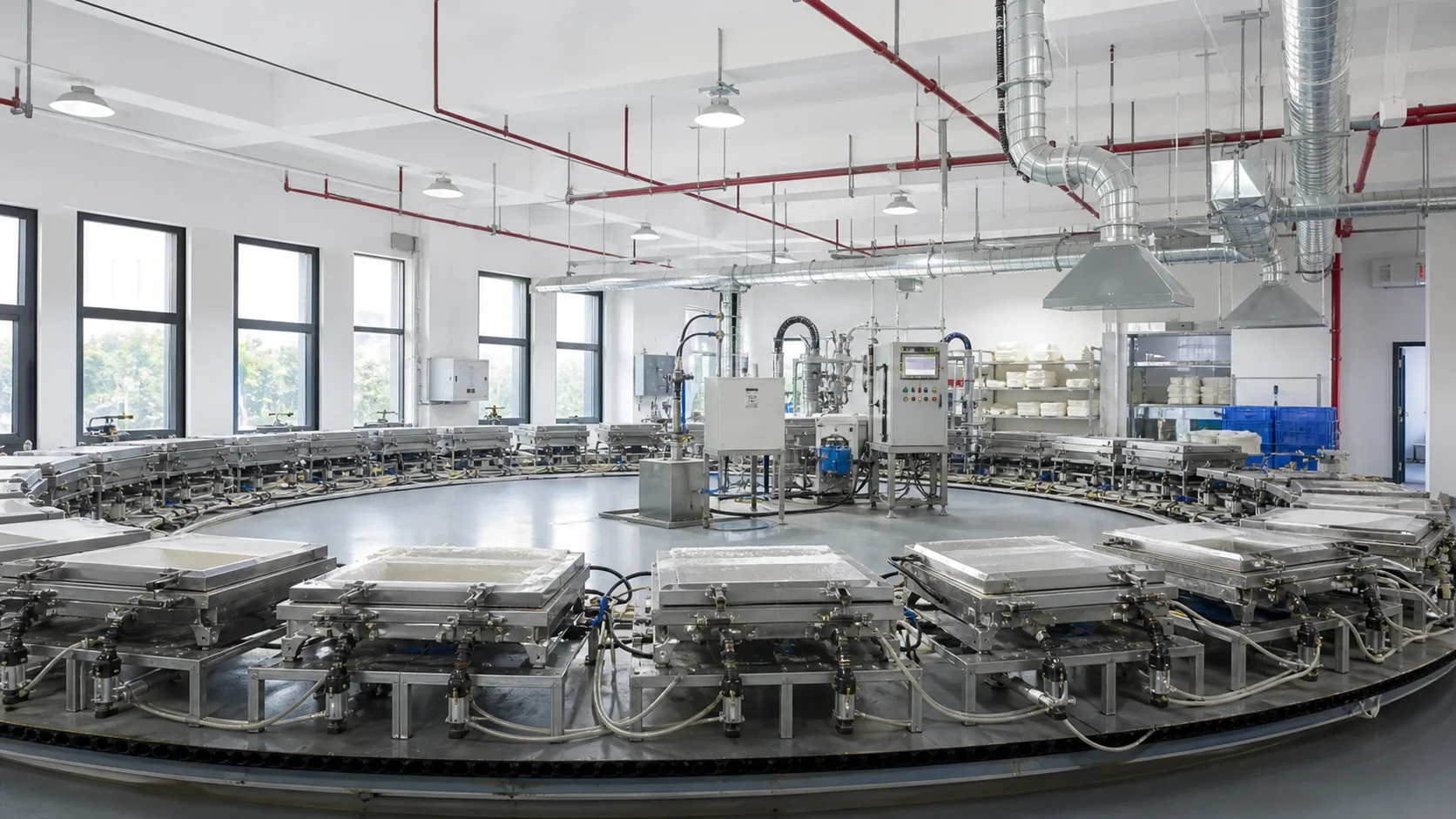
3. Molded core or cut core — two different products
There are two ways to turn foam into a pillow shape. Molding pours the reacting mixture into a heated aluminum mold shaped like the final pillow — this is how cervical contour waves, butterfly wings, U-shaped travel pillows and our dual-core designs are produced. The core comes out with a smooth molded skin, precise 3D geometry and batch-to-batch repeatability, at the cost of tooling: every new shape needs a machined mold. Cutting, by contrast, saws simple shapes out of large cured foam blocks or buns. It is fast and needs no tooling, which suits flat rectangular pillows and inner layers, but it cannot produce complex contours and the cut surface breathes differently from a molded skin.
For OEM buyers this choice is a real commercial decision: molded designs differentiate the product and hold their published dimensions, while cut designs reach lower price points and faster first orders. Our OEM/ODM page covers mold development timelines and minimums if you are weighing a custom shape.
4. Curing: the invisible step that decides odor and feel
Fresh out of the mold, a core is not finished — the polymer is still completing its reaction. Cores rest on ventilated racks for roughly 24 to 72 hours depending on formulation, density and season, letting the structure stabilize and volatile by-products escape. Skipping or shortening this stage is the single most common reason a new pillow arrives with a strong chemical smell: the off-gassing that should have happened in the factory happens in the customer's bedroom instead. It also causes cores to change firmness after purchase, because an under-cured polymer keeps hardening for days. We explain the odor mechanism in detail in our off-gassing guide.
5. Trimming, weighing and core inspection
Cured cores are demolded flash — thin excess foam at the mold parting line — and trimmed. Then comes the check that quietly controls quality: weighing. Because the mold volume is fixed, core mass is a direct proxy for density, and density is what buyers actually pay for — it drives durability, support and material cost. A 50D cervical core that weighs 8% light was foamed wrong, full stop. Cores are also checked for dimensions against the drawing, surface defects, voids and discoloration, and nonconforming cores are segregated before they can reach sewing. Our density guide for buyers explains how to specify and verify this number in a purchase contract.
6. Covers: patterning, cutting and sewing
While cores cure, the sewing workshop produces covers. A contoured pillow needs a 3D pattern — flat panels engineered so the sewn cover follows the wave or wing shape without flattening the support zones or leaving loose folds. Fabric (polyester knits, Tencel blends, cooling-yarn knits, or functional fabrics with gel-printed surfaces) is spread, cut in stacked layers, bundled by size and color lot, and sewn with the zipper, care label and brand label in specified positions. The inner liner cover, if the design has one, protects the foam during washing of the outer cover. Cover fit is checked on an actual core, not on a table: a twisted seam or a wrong stretch direction changes both the look and the loft of the finished pillow.
7. Assembly and finished-product QC
Assembly pairs each core with its liner and outer cover, orients dual-core or insert designs the right way up, and closes zippers. Finished pillows then pass final inspection: appearance and seam quality, dimensions and loft, zipper function, label content, and needle or metal detection where the destination market requires it. Sampling plans (commonly AQL-based) define how many pieces per lot are checked and what counts as a critical, major or minor defect. The pillows that pass are staged for packing with traceability back to the production order and foam batch — which is what makes a customer complaint months later diagnosable.
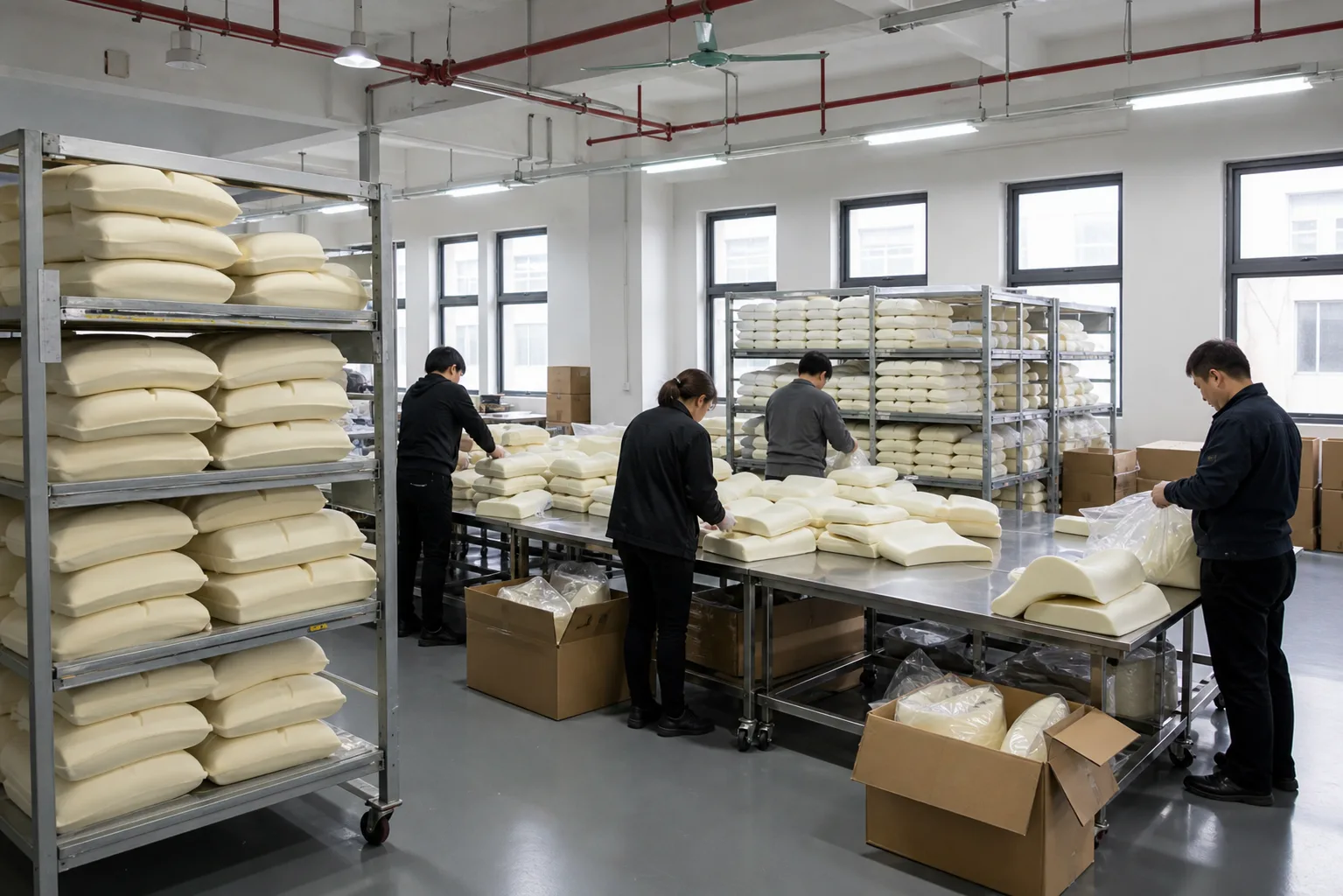
8. Vacuum compression and export packing
Memory foam ships mostly as air, so almost every export pillow is vacuum-compressed — sealed in a barrier bag, evacuated, and often rolled or folded — cutting shipping volume by 50–70%. Done correctly, the core recovers its full shape within hours of opening. Done carelessly, compression creates the defects customers photograph in reviews: permanent creases, slow or partial recovery, wrinkled covers and trapped odor. The variables that matter are how long after molding the core is compressed (curing again), the compression ratio, how long it stays compressed, and the bag's seal quality. We published a separate protocol for validating this: the vacuum compression packaging test guide. Compressed pillows are packed to a carton specification — count, orientation, carton strength, shipping marks — that has to survive parcel networks, not just a container.
9. The tests behind the claims
Everything printed on the retail box traces back to a test somewhere in this process. Foam safety claims rest on material certifications such as CertiPUR-US® (low VOC, no listed flame retardants or heavy metals) and cover fabrics on OEKO-TEX® Standard 100; electronics-free products destined for the EU may still need RoHS conversations for components like zipper pulls. Physical performance — indentation hardness, rebound time, compression set, durability cycling — is measured on defined instruments, not judged by hand. Cooling claims need a mechanism (contact-cool fabric, gel layer, ventilation channels) plus data. Our certifications guide explains what each badge does and does not cover, and the quality and compliance page shows the evidence we hold as a factory.
10. What this means if you are buying, not making
Understanding the process changes the questions worth asking a supplier. Instead of 'can you make memory foam pillows,' ask: which shapes are molded in-house and on which machines; how long cores cure before compression; how core weight is recorded per batch; how cover patterns are approved and controlled; what the compression recovery standard is for the exact SKU; and which test report supports each claim you plan to print. A factory that answers those six questions specifically — with records, not adjectives — will deliver the same pillow on the third order as on the first. If you want to see how we answer them, start with a sample: send your target shape, density, cover and market, and we will build it.
The production line at a glance
- Polyol + isocyanate + additives react and expand into viscoelastic polyurethane foam.
- Molded cores give contoured, repeatable 3D shapes; cut cores suit simple flat designs.
- 24–72 h curing and ventilation decide odor level and final firmness.
- Core weight per batch verifies density — the number that drives durability and cost.
- 3D-patterned covers are sewn, fit-checked on real cores, and labeled to spec.
- Final QC inspects appearance, dimensions, zippers and labels against the approved sample.
- Vacuum compression cuts shipping volume 50–70%; recovery must be validated per SKU.
- Every printed claim should trace to a named certification or test report.
Want to see the process applied to your pillow?
Send your target shape, density, cover fabric and market. We will quote the right process — molded or cut — and build a sample from our Dongguan factory.
Request a factory sample↗